Dawson Ahrenstoff on momentum and those who hold the camera
I was scrolling on Instagram in seat 12A departing from Nashville when I was reading comments on another Montana State Bobcats Football post. You couldn’t wipe the smile off my face, still buzzing off the Cats’ first national championship since 1984 the night before.
Suddenly I was back in 2019. Trying to come up with a caption for a hype video I just made. I thought of the gold standard of FCS football accounts at that time, and how we could catch up to them. Continuously posting creative ways to maximize our engagement and following. A benchmark analytic I found while writing this showed that in August of 2019, @msubobcatsfb had 8,625 Instagram followers.
So right before taking off, I checked. North Dakota State has had everybody beat for forever in every category: national championships, NFL talent, stadium attendance, AND social media followers. And we knew it too after running into them time and time again in the postseason.
- 2018 second round loss
- 2019 semifinal loss (Cats first semifinal since ‘84)
- 2021 national championship loss (my final game filming as a student)
- 2023 second round loss
- 2024 national championship loss
Setting aside the Jackson State caveat due to the Coach Prime Effect, the Cats had been competing against the Dakota State schools, JMU, and a herd of northeast programs for most of social media’s existence. But less than 24 hours after the Bobcats pulled off their dramatic overtime victory in Vanderbilt’s stadium, my refreshed phone screen said Montana State had surpassed NDSU’s Instagram follower count at 61,000.
Does that even mean anything? Honestly, not really. You can’t exactly make the argument that teams win games because they have the sweetest graphics or most viral recap videos. Or say that a program is more prestigious based on their elite Facebook analytics. Except for this one word that comes to mind: momentum.
Three days after moving into my South Hedges dorm freshman year in 2017, I crafted an email to Garrett Becker, MSU’s Director of Creative Services, asking about an opportunity to shoot video or photos for Bobcat Football. Social media had taken off several years ago, Facebook gaining popularity in the mid-late 2000s, Twitter launching in 2007, and Instagram in 2010. But at this point and time, content being posted to social platforms really began to become an opportunity for teams to establish their presence in an online format.
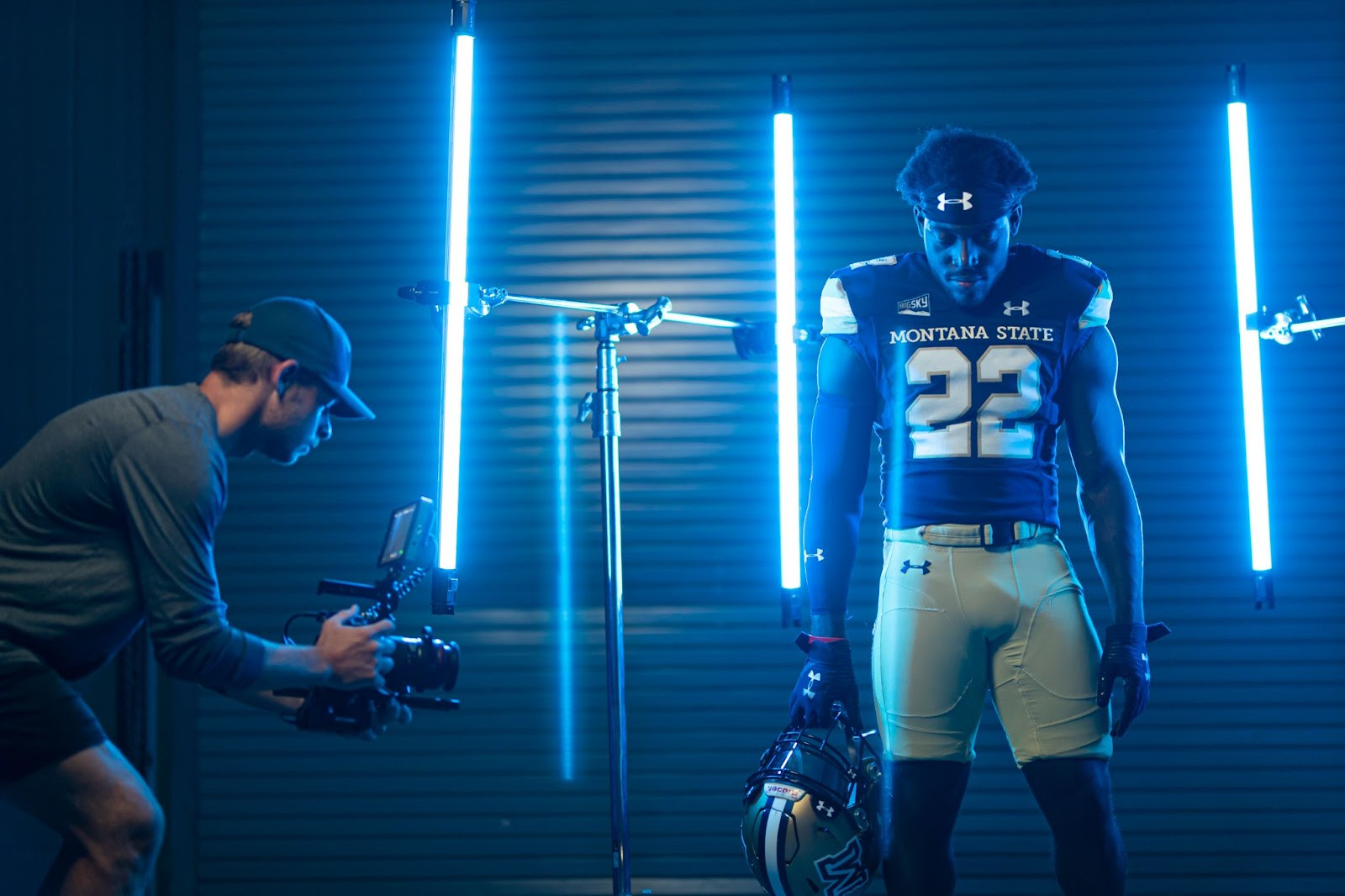
FCS schools, of course, will not always be able to compete on the turf against the Oregons and Texas Techs of the world, but the level playing field is found on social media. Everybody has a chance to be seen. A big reason there are so many Dallas Cowboys fans across the country, and even still today, is because in the 70s and 90s they dominated the NFL. Meaning they also dominated the newspapers, TV ratings, and kitchen table conversations. When winners win, they get the spotlight. Champions earn attention that demands respect, which in turn, is passed down generationally.
You won’t always find Big Sky football games filling the weekend ABC primetime slot, which is why social media is all the more important. The beautiful thing about sports is that anything can happen on any given day. And those who are there to witness it and capture it should always capitalize on their moment, because documenting moments is documenting history.
Freshman year me didn’t have that philosophy fully fleshed out yet, but I got to work. Holding lights, charging batteries, and filming an angle to be used only if everybody else somehow missed the shot (GTS: always get the shot). I had to earn and work my way up to a primary shooter. But this is not a story about young Dawson earning his stripes. Rather it is about the responsibility entrusted to the man who holds the camera.
My good friend Jack Murray, MSU alum and current Assistant AD of Brand Advancement at U of Washington Athletics, recalled a 2015 Bobcat Football game in which Drummond, MT native Mac Bignell obliterated a running back in the open field. The play happened right in front of his Panasonic camcorder. He uploaded the monster hit to Twitter, and woke up the next morning with hundreds of retweets and favorites. A moment that spoke value in capturing the occasion effectively.
My time at MSU had many moments just like that. It was unique, in my opinion, because year after year the Cats got better. And I had a front row seat… literally.
Sophomore year in Missoula with 14 seconds left on the clock, I ditched my long lens for a shorter one and sprinted 120 yards to the endzone where Tucker Yates, Chase Benson, Grant Collins, and Derek Marks made one of the greatest plays in Bobcat Football history. My lens was zooming out, zooming in, then back out again, I couldn’t believe what had just happened.
An assignment from FILM 371, a junior year documentary production class, had me thinking, “I’m nowhere qualified to make a documentary about the most dramatic Cat/Griz game in 118 years.” But if I didn’t take the chance to tell the story of that game, then somebody else would.
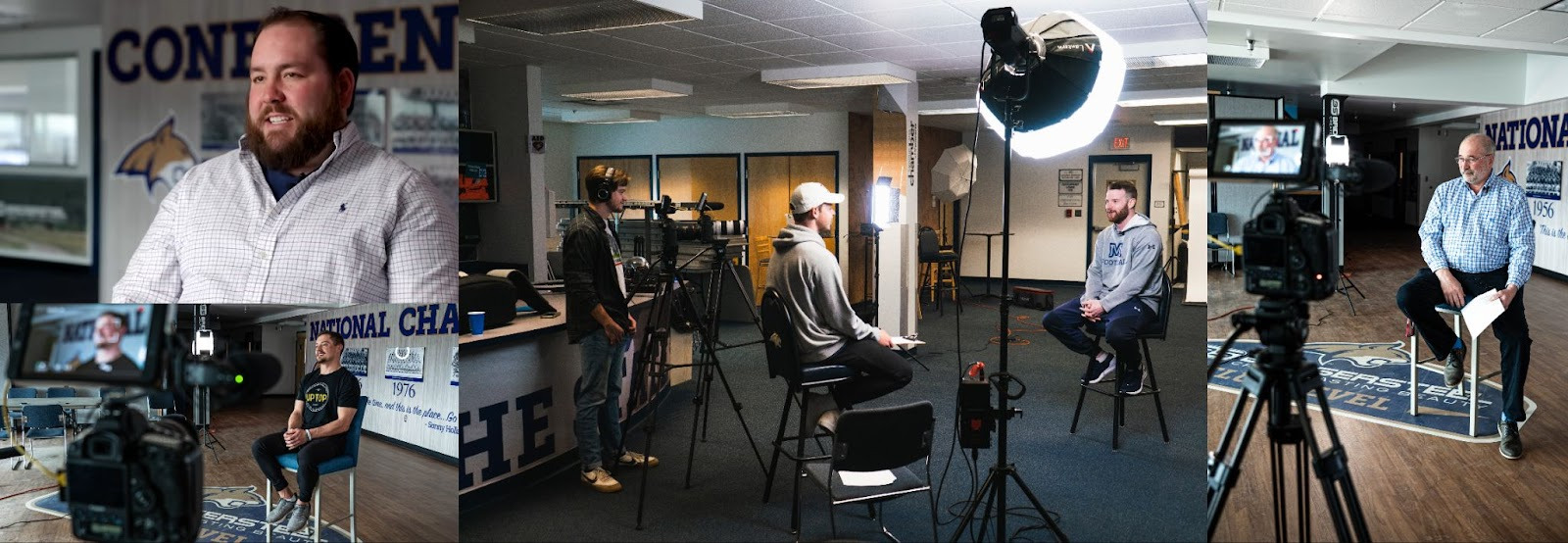
The class project stood no chance at staying under the required seven minute time limit. We raised $18,000 in under 72 hours which went directly into funding film costs. Who knew an original music score cost so much? Safe to say Bobcat Nation wanted to see this story get told. Months later, 500 people were chanting those famous words to the sound of Mony Mony as credits rolled in a packed Emerson theater in Bozeman.
Fall of 2019, the Cats crushed the Griz definitively by a score of 48-14, claiming their fourth consecutive Brawl of the Wild win. MSU’s first time accomplishing a four-peat in 44 years (1972-75). I remember wrinkled Bobcat fans coming to the football facility after that game thanking the coaching staff for routing Montana so badly. A margin of victory their eyes had not seen since young men.
This momentum I’m writing about can also be found in the line of video creatives from Montana State. Where would I be without trailblazers before me? Conner Firstman was creating game trailers and hype videos as a student back in 2010. He loved Bobcat athletics and that passion showed in his videos. Conner lost his battle with cancer in 2014, and a scholarship was established in his name that I was blessed to receive. Guys like Johnny Randazzo, Brian Morse, Jack Murrey, and Garrett Becker showed me how to be dedicated to a craft and to care for it. To give anything less than my best is a disservice to the program and to those who poured into me.
Through many games that I filmed from the sidelines I learned the importance in capturing a great shot. It sounds simple, but for a multitude of reasons. For one, the immediate response is that all of a fanbase will want to rewatch that highlight and share it. Two, when archived properly, that shot lives on for the rest of time. It became part of my shooting philosophy that when I record this goalline stand, or game winning PAT, I want whoever is digging through the archives 10, 20, 30, 41 years from now to say, “Man, this guy got the shot.”
It felt like a storybook ending to my time as a student filming for the Bobcats. A shot at the national championship to end the 2021 season, an opportunity to beat the Bison, and we didn’t even have to go to Fargo! But part of the job is to also tell the story when coming up short. An emotional Tucker Rovig walking off the field, tears in his eyes, savoring one last Bobcat applause. Ty Okada consoling Daniel Hardy lingering on the hashmarks. And there’s proof of that pain. Because the story does not stop when the clock hits zero.
It’s hard to measure creative value. Impossible really. But places that value it, give opportunities to document history. Louisiana State University Athletics gave me one of those opportunities after graduation where I got to spend two and a half years filming and telling stories about Paul Skenes, Dylan Crews, Tommy White, Jayden Daniels, Will Campbell, and Seimone Augustus among other LSU greats in Baton Rouge.
Athletics are the front porch to a university. Teams generate unexplainable exposure that often gives a person their impression—or lifelong fandom—of an institution. When those teams are rolling, the cameras must also roll. History doesn’t preserve itself. This can be argued for any type of medium; radio, photography, writing, print, or even word of mouth. Wins and losses demand creative interpretation, or else history collapses into a box score.
I’m proud of the way my alma mater has continued to do that. The exponential growth in an online presence, the intentional storytelling projects that engage an audience, and keeping in mind the fans who make this whole thing go around. Followers, analytics, and fandom don’t just happen. It’s laid out, brick by brick pairing team success with creative intention because momentum lasts when memories are built.